
A contractor drags a trolley across the lobby and leaves a snag in the carpet tile. A coffee urn overflows in the pantry corridor, and within weeks the backing starts to delaminate. A busy lift lobby shows a crushed, matted strip that no amount of vacuuming will fix. These are the moments when a facility manager has to make a call: repair or replace?
The honest answer is that replacement is often the wrong reflex. Localised damage in an otherwise sound carpet can almost always be addressed more cheaply, more quickly and with far less operational disruption than a full strip-out and re-lay. The trick is knowing which damage types respond well to repair, and which have progressed too far.
This guide covers the most common office carpet damage scenarios in Singapore, the repair options available, and the decision framework that helps you choose the right path before you call anyone.
Why this matters: Replacing office carpet prematurely is one of the most avoidable capital expenditures in facilities management, and in Singapore's humid climate, a missed repair window often turns a simple fix into a full section replacement.
Highlights
- Localised carpet damage, burn marks, snags, delaminating tiles, frayed seams, can often be repaired without replacing the whole floor.
- Singapore's humidity accelerates moisture-related delamination; catching it early is the difference between a patch and a full re-lay.
- Big Red's rug repair and restoration service handles pile crushing, seam separation, fraying and structural damage to both broadloom and carpet tiles.
- In-house IICRC- and CRI-certified technicians, never sub-contracted, with same-day and 24/7 availability.
- The 30-Day Delight money-back re-clean guarantee backs every job.
The most common office carpet damage types in Singapore
Before weighing repair against replacement, it helps to name what you are actually dealing with. The damage types we see most often in Singapore commercial spaces fall into four categories.
Carpet tile displacement and delamination
Carpet tiles are the workhorse of Singapore's office fit-outs, and for good reason: individual tiles can be lifted, cleaned and replaced without touching the rest of the floor. But displacement, where tiles shift or curl at the edges, and delamination, where the backing separates from the face fibre, are two different problems.
Displacement is usually a re-adhesion job. A tile that has lifted at the corner because the original tackifier dried out can be re-laid with fresh adhesive, often within the hour. Delamination is trickier. If moisture has worked its way under the tile, typically through a leak, a pantry spill that was not dried properly, or simply Singapore's ambient humidity in a poorly air-conditioned storeroom, the backing can degrade. Tiles in that condition may need replacement, but only the affected section, not the whole floor.
This is where early intervention matters most. A delaminating tile caught at three tiles is a patch. Left for six months, it can spread to thirty.
Seam separation in broadloom carpet
Broadloom carpet is seamed during installation, and those seams are a weak point in high-traffic areas. A seam that starts to separate, visible as a ridge or a gap running in a straight line, looks worse than it is. In most cases, the carpet itself is sound; only the seam has failed. A professional can re-bind the seam with a heat iron and fresh seaming tape, or inject seam sealer, and the repair is essentially invisible.
Left unattended, a separated seam becomes a trip hazard and the gap collects soil, which makes the problem harder to remedy later.
Burn marks, snags and pile damage
These are the most straightforward repairs in principle. A cigarette burn or a hot object dropped on a carpet tile damages a very small area. The standard fix is a patch: a matching tile or a cut piece from a remnant (which is why good facilities managers keep a few spare tiles from the original installation) is inserted in place of the damaged section. Done well, the patch is difficult to spot.
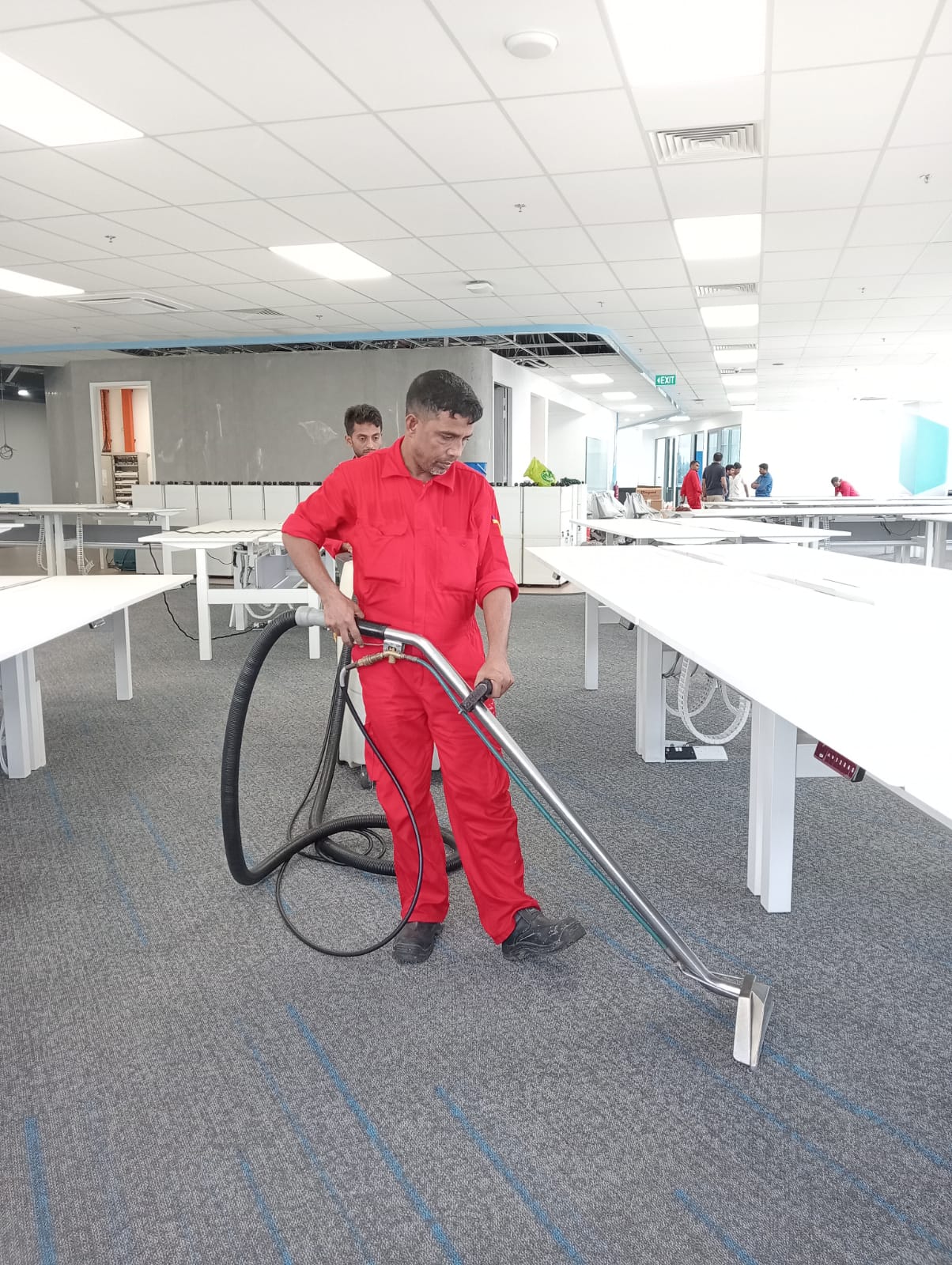
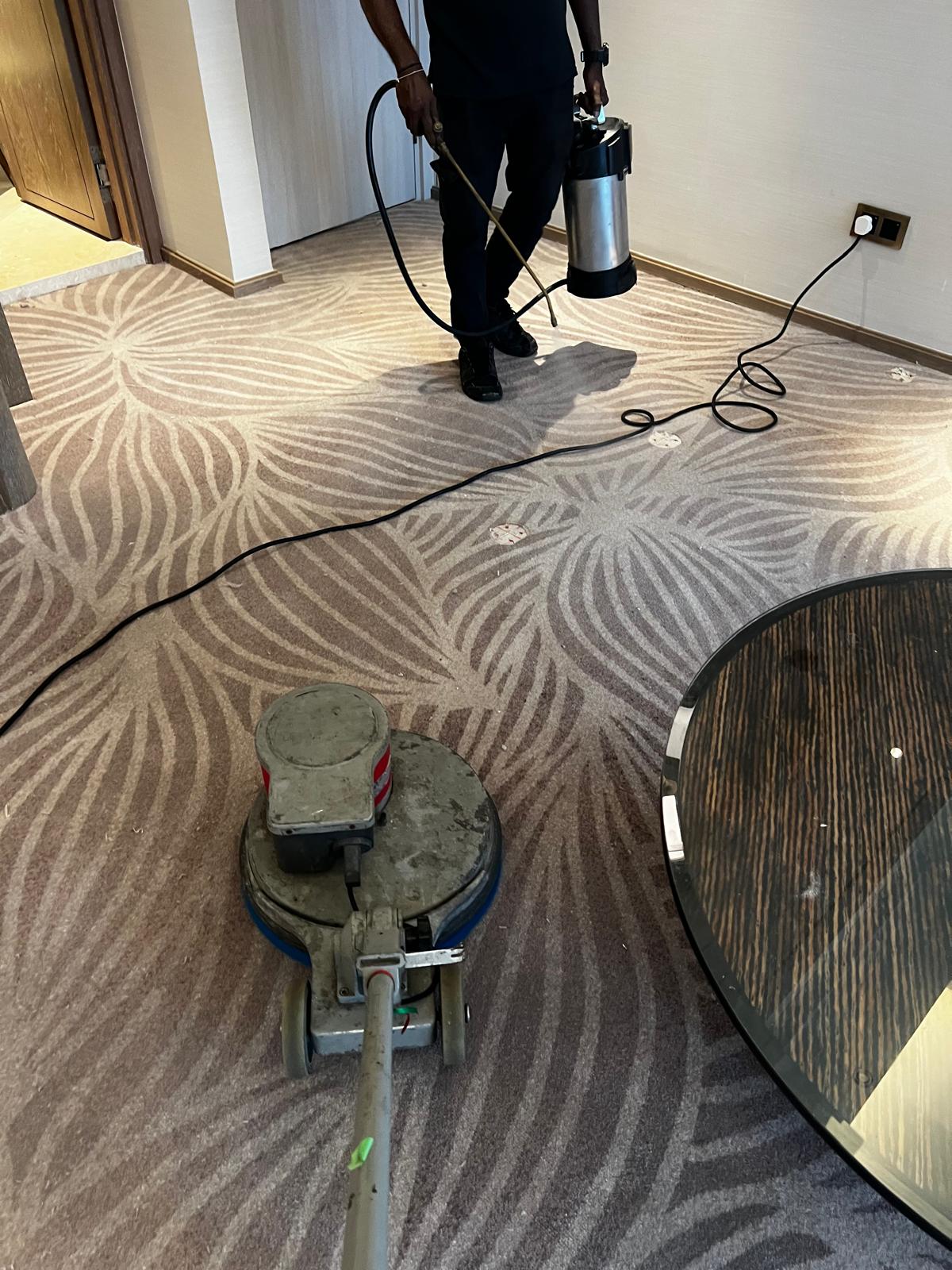
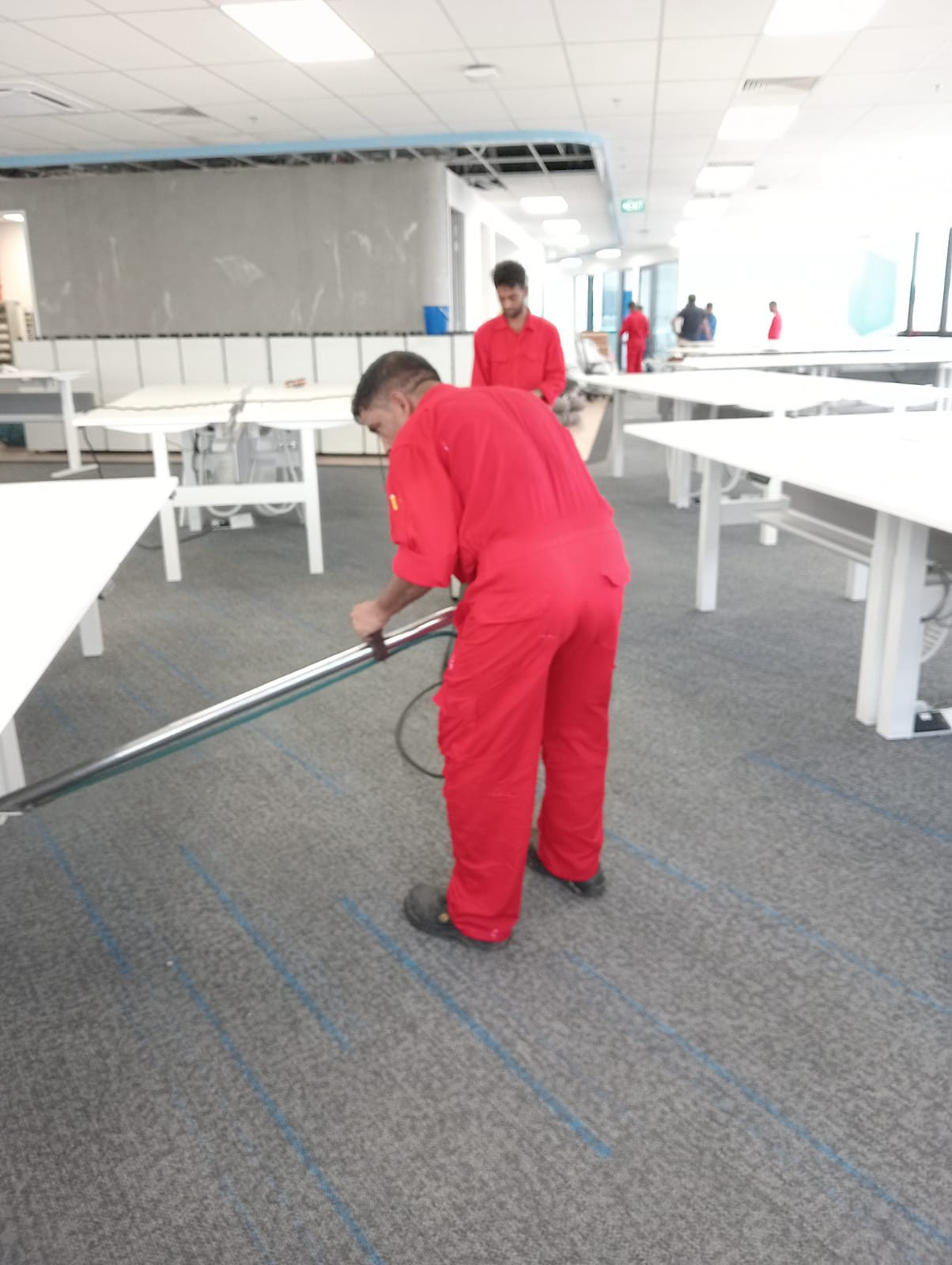
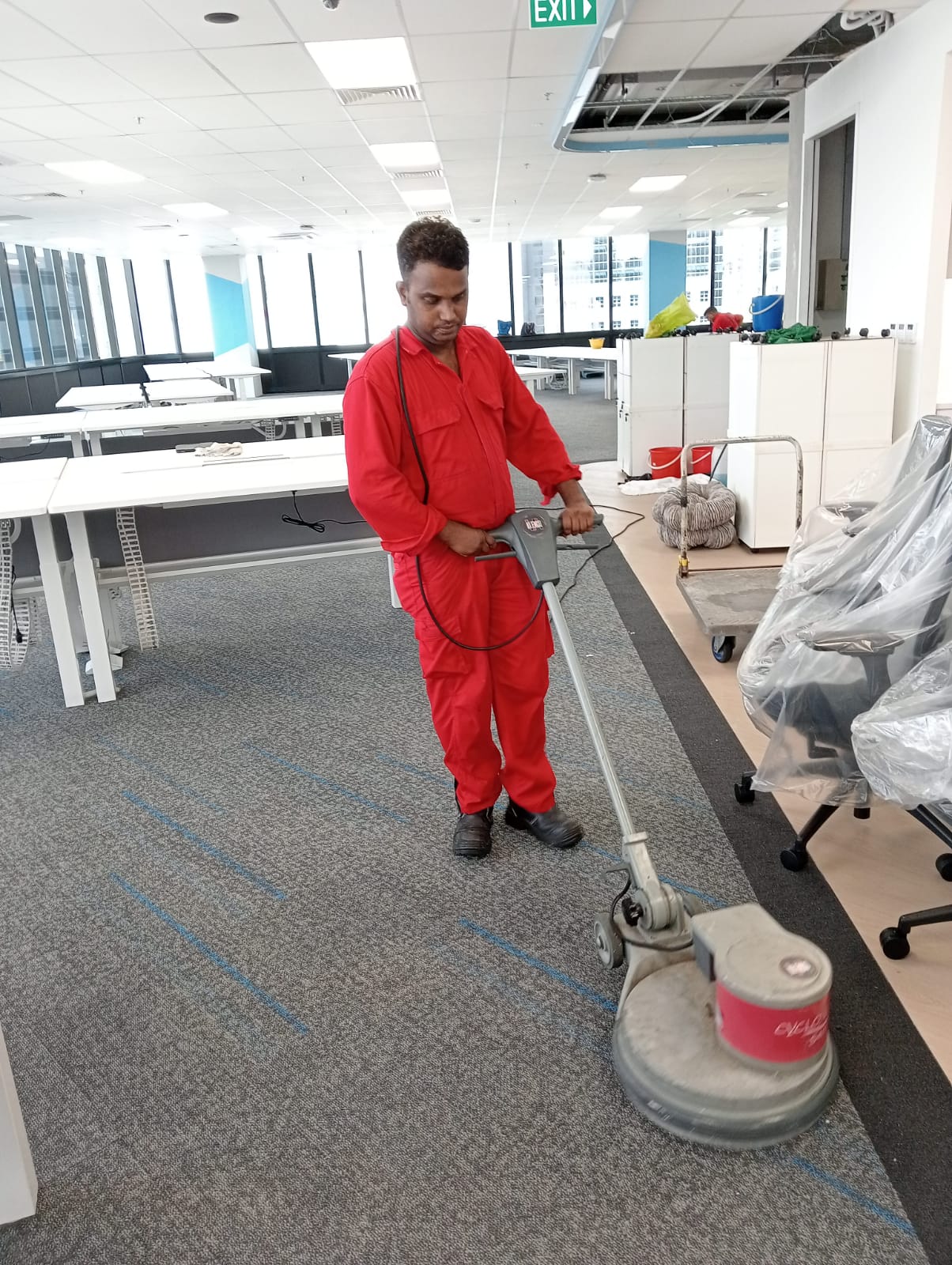
Snags, where a loop-pile fibre has been pulled, are often fixable without replacement at all. The loop can be re-seated or trimmed flush depending on the construction. Pile crushing in high-traffic corridors, the flat, matted look that develops under chairs and in front of lifts, responds well to a professional hot-water extraction clean, which lifts the pile with heat and agitation. If the pile has been crushed permanently, a section replacement may be needed, but this is less common than it looks.
Moisture-related damage and mould
Singapore's humidity is the one factor that distinguishes office carpet care here from a temperate climate. A spill that would dry out harmlessly in a drier city can sit in the carpet backing long enough to trigger mould growth, particularly in spaces with limited air circulation. This shows up as a musty smell before it shows up visually, which is why smell is the first warning sign to act on.
If the mould is confined to the face fibre, a professional extraction clean can address it. If it has reached the backing or the underlay, that section needs to come out. The professional carpet cleaning we carry out uses hot-water extraction with no chemical residue, which also removes the moisture that feeds mould rather than simply masking the smell.
Repair versus replacement: the decision framework
No single rule covers every situation, but this framework gives you a starting point before you call a contractor or a carpet supplier.
|
Damage type |
Repair viable? |
Repair method |
Replace when |
|---|---|---|---|
|
Carpet tile displaced / curled edge |
Yes |
Re-adhesion, fresh tackifier |
Backing structurally degraded |
|
Delamination (small area) |
Yes |
Patch affected tiles |
Spread across 20%+ of floor |
|
Seam separation |
Yes |
Re-seam with heat iron / seam tape |
Carpet face fibre also damaged |
|
Burn mark or snag (tile) |
Yes |
Patch with matching tile or remnant |
No matching tile available |
|
Pile crushing |
Often |
Hot-water extraction lifts pile |
Fibre permanently compressed |
|
Mould (surface only) |
Yes |
Professional extraction and dry |
Mould in backing or underlay |
|
Mould (backing / underlay) |
No |
Section replacement |
Entire area affected |
|
End-of-life wear (10+ years) |
Rarely |
Cosmetic only |
General wear throughout |
The 20% rule of thumb
A practical starting point: if the damaged or worn area covers less than 20% of the floor, repair or section replacement is almost always the better financial call. Above 40%, a full replacement is usually more cost-effective and gives you a uniform finish. Between 20% and 40%, it depends on the carpet's age, the quality of the original installation, and whether matching material is still available.
Age and residual life
A carpet tile floor in good condition has a typical service life of 10 to 15 years with proper maintenance. If your floor is three years old and has a damaged section, repair extends that investment by years. If it is 12 years old and showing general wear across the field, a repair buys months at best.
This is the calculation worth making before committing either way. Our team can assess a floor and give you an honest read on residual life, because a repair job that needs to be redone in six months is not actually a saving.
Matching material
For carpet tiles, the critical question is whether you have matching tiles in storage, or whether the original product is still available from the manufacturer. Carpet tile ranges are discontinued regularly, and a patch in a tile that is two generations behind the current field will be visible. This is a genuine constraint that sometimes tips the decision toward replacement sooner than the damage alone would justify.
When to call in a professional
DIY repair is possible for a single displaced tile or a snag in loop pile, and most facilities teams can manage basic re-adhesion with the right tackifier. But seam repair, patching broadloom, and any moisture-related work are jobs where a misstep makes things worse: an amateur heat-seam creates a visible ridge; over-wetting a carpet during a DIY clean drives moisture into the backing.
For seam separation, structural patching, or any job where the repair needs to be invisible (a client-facing boardroom, a hotel lobby, a retail floor), professional carpet repair is the right call. Big Red's rug repair and restoration team handles both broadloom and carpet tile work, and our IICRC-certified technicians assess each job before quoting so you are not paying for more than the situation requires.
Related: see why 7,000-plus Singapore homes and offices trust Big Red with their floors and soft furnishings.
For carpet stain issues that sit alongside structural damage, our carpet stain removal service is often done in the same visit, which avoids a second disruption to your team.
Frequently asked questions
Can carpet tiles be repaired without replacing the whole floor?
Yes, in most cases. Individual tiles can be re-adhered, patched with a matching replacement, or swapped out entirely without touching the surrounding field. The practical limit is matching material: if the original tile range has been discontinued, a visible colour or texture difference may make a full replacement the tidier outcome.
How do I know if moisture damage in my office carpet needs professional help?
The first sign is smell, typically a musty or sour odour that persists after vacuuming. If the smell clears after airing the space, the moisture is likely surface-level. If it does not, or if you can see staining or the backing feels soft and spongy underfoot, call a professional. Moisture in the backing or underlay does not resolve on its own in Singapore's humidity.
Is professional carpet repair cost-effective compared to buying new carpet tiles?
Usually yes, for localised damage. A professional patch or re-seam on a three-to-eight-year-old floor almost always costs less than a full section replacement and causes far less disruption to your operations. The exception is when matching material is unavailable, or when the damage covers more than a third of the floor area.
How long does a professional carpet repair take?
Most localised repairs, a tile patch, a re-seam, or a small broadloom patch, are completed within one to three hours. Moisture remediation that involves extraction and drying takes longer, typically half a day, and the carpet should be kept clear until it is dry to the touch, usually within four to six hours after extraction.
Does Big Red carry out carpet repair alongside cleaning?
Yes. We frequently combine a structural repair with a professional carpet cleaning in the same visit, which is more efficient for your team and ensures the repaired area blends with a freshly cleaned field rather than standing out against a soiled background.
The better question before any repair or replacement decision is always: what is the actual extent of the damage, and what is this floor's remaining useful life? Getting that assessment right saves money and avoids both premature replacements and repairs that merely delay the inevitable.