
Most FM contracts treat carpet cleaning as an afterthought: a single line that reads "periodic carpet cleaning as required" and leaves everyone arguing about what "required" means six months later. The result is either under-cleaned carpets that shorten the asset life, or unnecessary call-outs that blow the maintenance budget.
The problem is that a modern Singapore facility rarely has one floor type. You might have carpet tiles across an open-plan office, a wool-blend area rug in the reception, and nylon corridor runners that take foot traffic all day. Each of those surfaces has a different cleaning frequency, a different method, and a different tolerance for downtime.
Getting the schedule right at contract stage saves money, reduces friction with tenants, and keeps the asset looking presentable through its full service life. Here is how to do it.
Why this matters: A poorly scoped carpet cleaning contract is one of the most common causes of premature carpet replacement in Singapore commercial properties, and replacement costs far exceed the cost of planned maintenance.
Highlights
- Carpet tiles, area rugs and corridor runners each need different cleaning frequencies and methods, one schedule does not fit all.
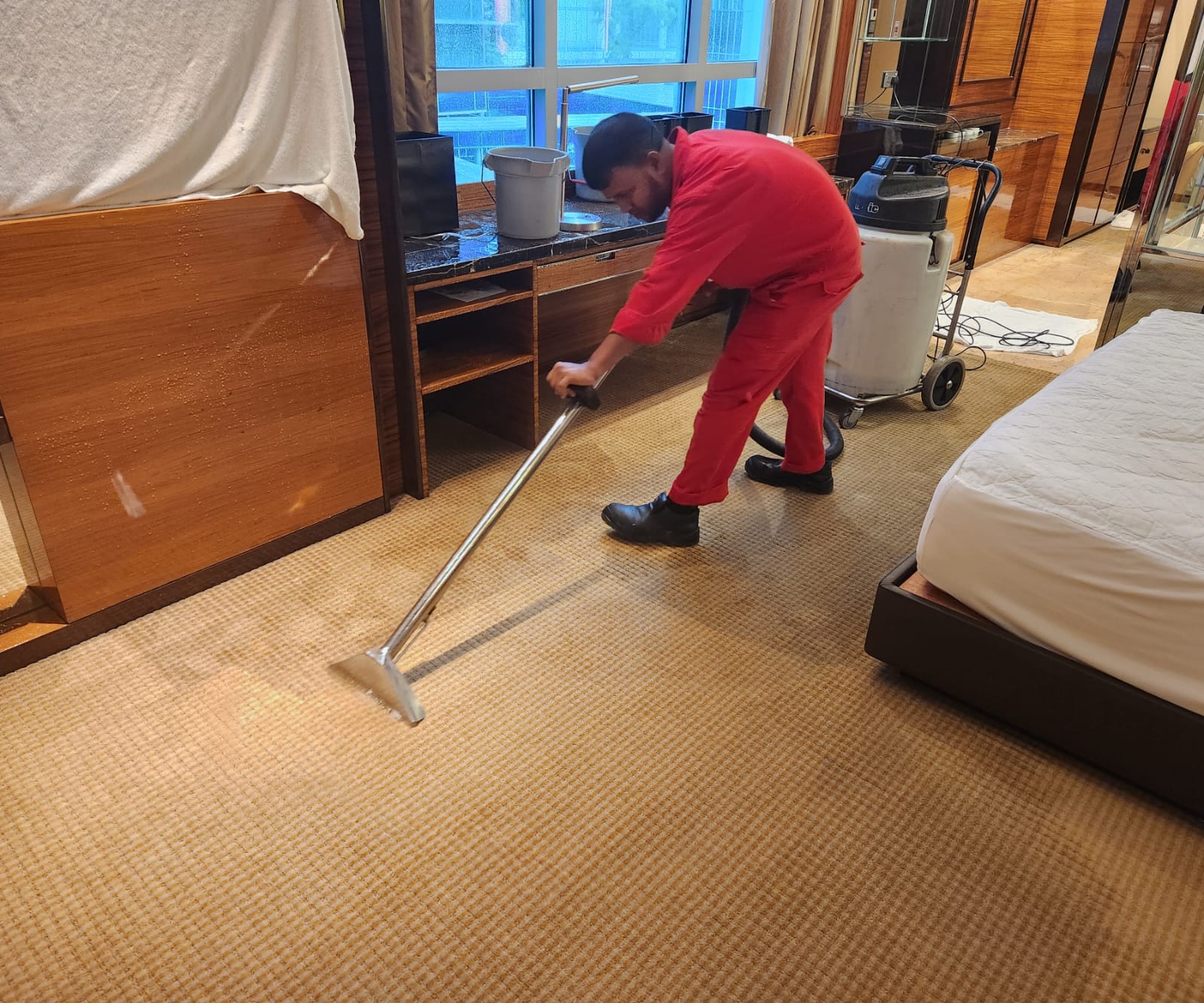
- Hot-water extraction removes roughly 96% of embedded soil, dust mites and odour with no chemical residue, making it the standard for deep periodic cleans.
- Big Red's solutions are eco-friendly and safe for occupied buildings, including clinics, schools and hotels.
- In-house IICRC- and CRI-certified technicians, never sub-contracted, with same-day and 24/7 scheduling to work around business hours.
- All work is backed by the 30-Day Delight money-back re-clean guarantee.
Understanding your floor types before you write the scope
The first step in any FM carpet and rug cleaning specification is a floor-type audit. Walk the facility and categorise every carpeted surface by fibre, pile construction and daily foot traffic. This is not pedantic: a wool area rug in a reception responds to mishandled hot-water extraction by shrinking or browning, while a polypropylene carpet tile in a back office is nearly indestructible and can take more aggressive cleaning.
Carpet tiles in open-plan offices
Carpet tiles are the workhorse of Singapore commercial interiors. They are almost always synthetic (nylon or polypropylene), modular and replaceable. Because individual tiles can be swapped out, spot replacement is often more cost-effective than a full deep clean for isolated damage.
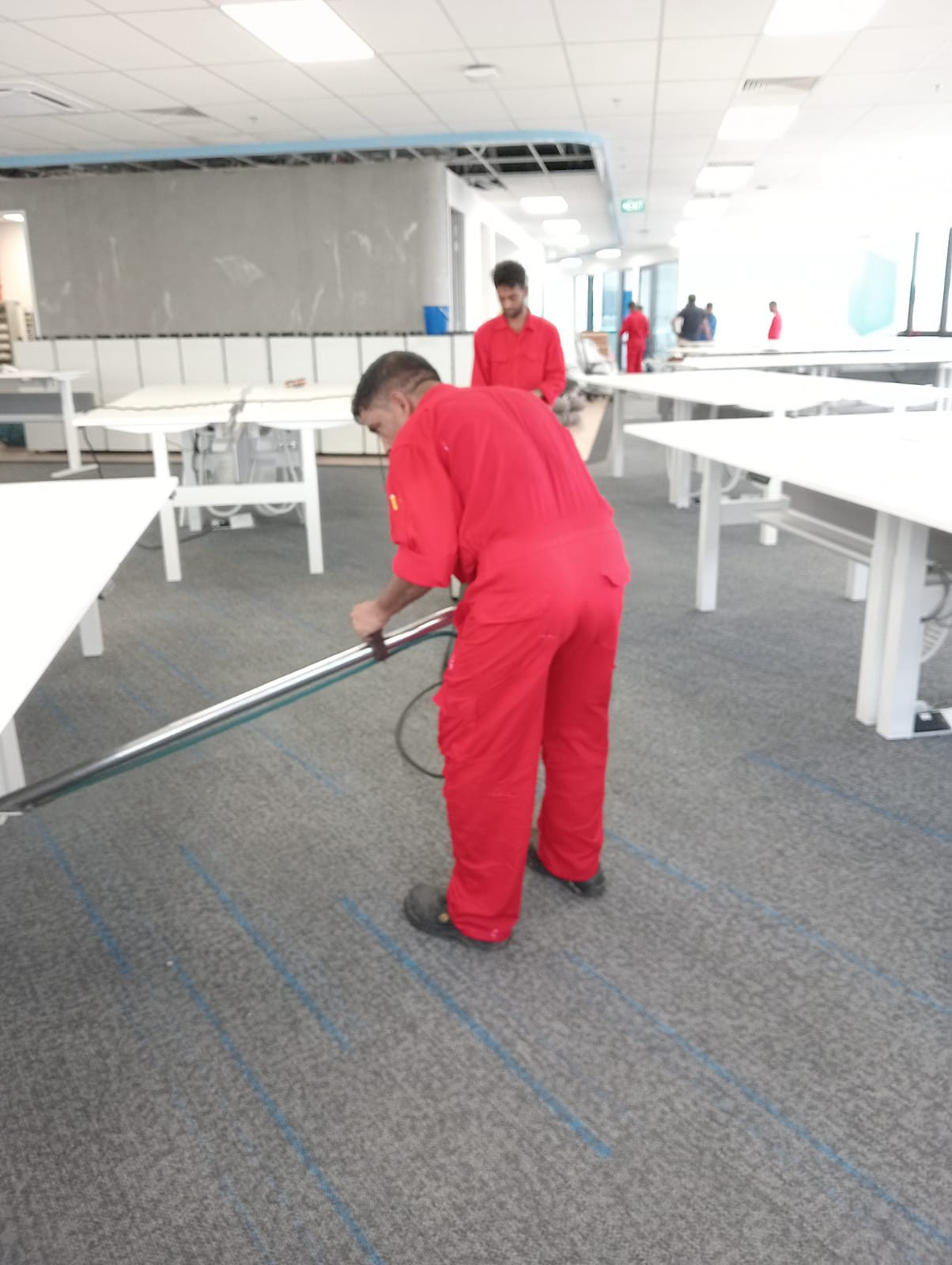
That said, tiles still accumulate embedded soil, VOCs and allergens across the whole floor, and regular professional carpet cleaning is the only way to address that. A typical open-plan office with moderate foot traffic (200–400 people per day) needs:
- Interim encapsulation or bonnet cleaning every 4–8 weeks to lift surface soil and maintain appearance between deep cleans.
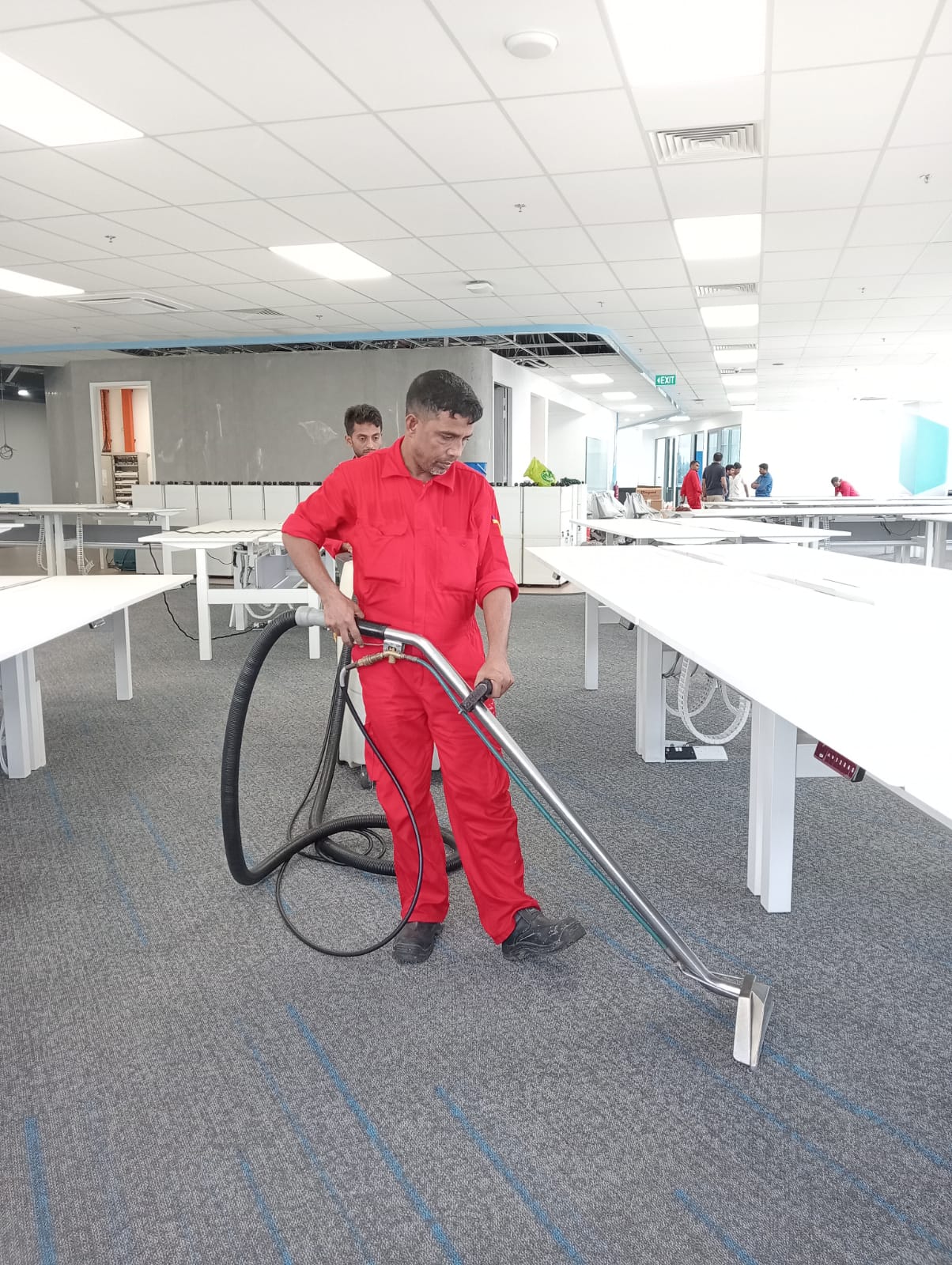
- Hot-water extraction (the deep clean that actually reaches the pile base) every 3–6 months, depending on foot traffic and occupancy.
Area rugs in reception and boardrooms
Reception area rugs are a different matter entirely. They are often made from natural fibres (wool, jute or sisal), hand-tufted or woven, and they sit on hard floors where wicking and shrinkage are real risks. They also represent a meaningful capital investment, so the cleaning method matters as much as the frequency.
For rug cleaning in commercial spaces, the scope should specify:
- Fibre type and any manufacturer warranty conditions (some wool rugs void the warranty if hot-water extraction is used without pre-testing for colourfastness).
- Cleaning method by rug type: dry encapsulation or low-moisture cleaning for sensitive natural fibres; hot-water extraction for synthetics.
- Frequency: typically every 6–12 months for a reception rug with moderate foot traffic, more often for a high-traffic lobby.
Corridor runners
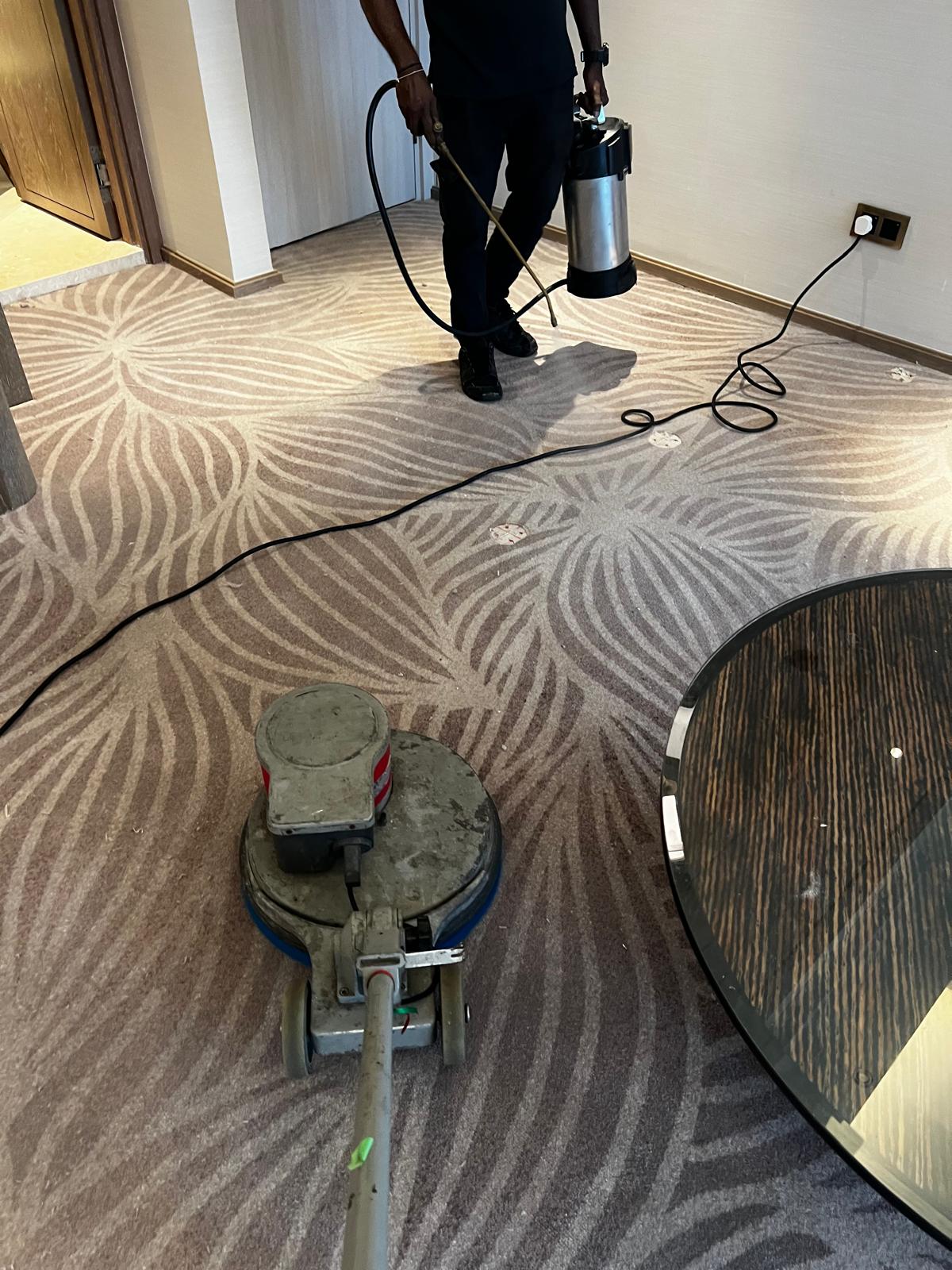
Runners take the most punishment of any soft floor covering in a commercial building. Foot traffic is concentrated on a narrow strip, and soil builds up fast. Because they are usually synthetic and low-pile, they can tolerate hot-water extraction well, but they dry slowly in a corridor where air circulation is poor.
Schedule runners for hot-water extraction every 2–3 months in high-traffic facilities (hotels, hospitals, schools), and specify that the clean is to be done outside business hours with the corridor section cordoned off during drying.
Setting cleaning frequencies: a practical framework
Once you have catalogued the floor types, you can write frequencies into the contract with confidence. The table below shows a practical starting point for Singapore commercial facilities. Adjust up if the building is in a dusty construction zone, if it allows outdoor shoes throughout, or if it houses a food-and-beverage operation.
|
Surface |
Foot traffic |
Interim clean |
Deep clean (hot-water extraction) |
|---|---|---|---|
|
Office carpet tiles (synthetic) |
Moderate (200–400 pax/day) |
Every 6–8 weeks |
Every 6 months |
|
Office carpet tiles (synthetic) |
Heavy (400+ pax/day) |
Every 4 weeks |
Every 3 months |
|
Reception / boardroom area rug (wool or natural fibre) |
Low–moderate |
Every 3–6 months |
Every 12 months |
|
Reception / boardroom area rug (synthetic) |
Moderate |
Every 2–3 months |
Every 6 months |
|
Corridor runners (synthetic) |
Heavy |
Every 4 weeks |
Every 2–3 months |
|
Hotel guestroom carpet |
Daily housekeeping (vacuum) |
Every 3 months |
Every 6–12 months |
These are baselines, not guarantees. A facility that runs a kitchen or a childcare centre will need to clean more often. A rarely used conference room may only need an annual deep clean. The point is to write the actual frequency into the contract so there is no ambiguity at review time.
What to write into the scope of work
Vague scope language is the most common source of contract disputes. Instead of "carpet cleaning as required", a well-drafted FM carpet and rug cleaning scope should specify:
- The surface reference (tile, area rug, runner, and the room or zone it covers).
- The cleaning method (hot-water extraction, encapsulation, bonnet, or low-moisture), not just "carpet cleaning".
- The frequency (monthly, quarterly, bi-annually) rather than "periodic".
- Access conditions: whether the clean is in-hours or out-of-hours, how much notice is required, and who is responsible for clearing furniture.
- Drying expectations: hot-water extraction by a professional leaves carpets dry to the touch in 4–6 hours. If same-day re-occupancy is required, specify it and confirm the contractor can deliver it.
- Proof of certification: require IICRC-certified technicians and specify that the contractor does not sub-contract the work. This is the clause most FM managers overlook, and it matters when a natural-fibre rug is damaged by an under-trained operative.
Related: see why Changi Airport and Shangri-La Hotel trust Big Red with their floors.
Managing disruption around business hours
The most technically correct cleaning schedule is useless if it cannot be delivered without closing the building. Singapore facilities often run extended hours, and some (hospitals, hotels, data centres) never close. Any FM carpet and rug cleaning contract needs to address this directly.
Out-of-hours and after-hours scheduling
Hot-water extraction equipment is not quiet, and the drying phase requires adequate ventilation and ideally foot-traffic exclusion for 4–6 hours. For most open-plan offices, a Friday-evening clean gives the carpet the weekend to dry and return the space to full occupancy on Monday.
For facilities that cannot tolerate even a Friday shutdown, low-moisture encapsulation is a practical alternative for the interim cleans. It dries in under an hour and does not require the same clearance time. The trade-off is that encapsulation lifts surface soil and maintains appearance, but it does not reach the base of the pile the way hot-water extraction does. A contract that uses encapsulation for the interim cleans and schedules hot-water extraction during a planned building shutdown (annual leave periods, public holiday weekends, planned maintenance windows) gets the best of both methods.
Coordinating with other FM trades
Carpet cleaning should be sequenced after any dusty trades (air-conditioning filter changes, electrical work, ceiling tile maintenance) and before any client-facing events or inspections. A post-renovation carpet and rug clean is a separate line item from the scheduled maintenance clean, so write that explicitly into the contract if the facility is in an active fit-out or refurbishment cycle. The article on curtain cleaning before and after a renovation covers a similar sequencing logic for soft furnishings that applies equally here.
When to escalate beyond scheduled maintenance
Scheduled cleaning keeps a carpet in good condition, but it does not address everything. There are situations where the FM team needs to act outside the planned schedule:
- Large liquid spills (coffee, water, oil): address within the first hour. Blot, do not rub. If the stain involves a natural-fibre rug or a light-coloured carpet, call a professional rather than applying a retail spray, which can set the stain or leave a residue that accelerates re-soiling. Our carpet stain removal service is available same-day for urgent commercial situations.
- Flooding or water ingress: do not wait for the scheduled clean. Water-damaged carpet that is not dried and treated within 24–48 hours risks permanent browning, wicking and mould growth.
- Visible mould or musty odour: this is a hygiene issue, not just an appearance issue. Hot-water extraction with an appropriate sanitising agent addresses both the mould and the odour at the source.
- Pre-event or post-event cleans: a one-off clean before a major client presentation or after a staff event should be budgeted separately and not counted against the scheduled maintenance cleans.
For facilities managers who need a structured way to vet a cleaning provider before awarding a contract, the article on choosing a carpet cleaning company for a hotel in Singapore covers the same due-diligence questions that apply to any commercial FM scope.
Frequently asked questions
How often should carpet tiles in a Singapore office be deep-cleaned?
For most Singapore offices with moderate foot traffic, a hot-water extraction deep clean every 3–6 months is the right baseline. High-traffic areas (entry lobbies, corridors, breakout zones) benefit from more frequent interim encapsulation cleans every 4–8 weeks to maintain appearance and extend the time between deep cleans.
Can hot-water extraction be done in an occupied building?
Yes, in most cases. Big Red's equipment operates with commercial-grade extraction that leaves carpet dry to the touch in 4–6 hours, and our solutions are eco-friendly, with no harsh chemical residue. We regularly clean occupied hotels, clinics and offices out-of-hours or in sections, so normal operations continue in unaffected zones.
Should area rugs be cleaned differently from carpet tiles in a commercial space?
Almost always, yes. Area rugs, particularly those made from wool, jute or sisal, require a lower-moisture approach and a colourfastness check before any wet method is applied. Carpet tiles are almost always synthetic and can take hot-water extraction without risk of shrinkage or browning. The cleaning method should be specified by surface in the FM contract, not left to the technician's discretion on the day.
What should a carpet cleaning clause in an FM contract actually say?
At minimum: the surface type and location, the cleaning method (hot-water extraction or encapsulation), the frequency (monthly, quarterly, bi-annually), access and notice requirements, drying-time expectations, and a requirement for IICRC-certified in-house technicians. "Carpet cleaning as required" is not a scope, it is a recipe for a dispute.
What is the Big Red guarantee for commercial FM contracts?
Every clean we carry out is backed by the 30-Day Delight guarantee: if you are not satisfied with the result, we return and re-clean at no charge. For ongoing FM contracts, this applies to each scheduled clean individually, so there is a clear remedy at every service visit without renegotiating the contract.
Ready to scope your FM carpet cleaning contract?
Big Red Carpet Cleaners has been working with facilities managers across Singapore since 1986. We will help you specify the right methods, frequencies and access windows for your building, and back every clean with the 30-Day Delight guarantee.
Get a free quote or contact us directly:
- Call: 6241 9443
- WhatsApp: 9222 9222
- Email: info@bigred.com.sg