A homeowner calls us because their carpet smells musty a week after they cleaned it themselves. Another calls because a stain they tried to scrub out has spread into a pale halo that no amount of effort will shift. A third calls because their "freshly cleaned" carpet is dirtier than before within days of renting a machine from the supermarket.
These are not unusual calls. After 40 years of professional carpet cleaning across Singapore homes, HDB flats, condos and landed properties, we have seen every variation of these situations. The mistakes behind them are consistent, and they are almost always fixable, though a few are not.
This is what four decades of cleaning carpets in one of the world's most humid cities has actually taught us.
Why this matters: The mistakes most homeowners make with their carpets are not obvious, and in Singapore's climate, they can turn a fixable problem into a permanent one faster than anywhere else.
Highlights
- Rubbing a spill drives it deeper into the pile and spreads it; blotting is always the right first move.
- DIY shampoo machines leave sticky residue that attracts soil faster than a clean carpet would.
- Over-wetting a carpet in Singapore's humidity creates the conditions for mould and browning.
- Hot-water extraction removes around 96% of embedded soil, dust mites and odour with no chemical residue.
- Big Red's in-house IICRC- and CRI-certified technicians, never sub-contracted, with same-day and 24/7 service.
- Backed by our 30-Day Delight money-back re-clean guarantee.
The mistake that ruins more carpets than any other: rubbing the spill
Every week, someone calls us about a stain that has grown. A coffee spill was the size of a 50-cent coin; after scrubbing, it is palm-sized. A splash of red wine is now a pale, spreading halo. The fibre around the original mark has been abraded, and the stain has been pushed down through the pile and spread sideways.
Rubbing feels like the obvious response to a spill. It feels active, like you are doing something. But carpet pile is not a hard surface. The fibres twist and interlock, and friction forces liquid deeper while spreading it outward. The more pressure you apply, the more the stain sets.
What to do instead
Blot from the outside of the spill inward, using a clean, dry cloth or paper towel. Press down and lift, rather than wipe across. Work toward the centre, never away from it. For most fresh spills, this alone removes enough liquid that the stain does not set.
For red wine and other tannin-based stains, a small amount of cold water applied after blotting can dilute what remains. The key word is small: adding too much water creates its own problem, which brings us to the next mistake.
Over-wetting: the mistake Singapore's climate makes worse
Singapore sits at roughly 84% average relative humidity. When a carpet gets saturated, moisture does not evaporate quickly, even with fans running. It sits in the backing and the underlay, and in our climate, mould can begin to develop within 24 to 48 hours.
We see over-wet carpets most often after a DIY clean with a rented extraction machine or, more commonly, after a homeowner has applied water generously to a stain. The carpet feels damp for days, then starts to smell. By the time we arrive, the odour is sometimes coming from below the carpet rather than the pile itself, and there may be visible browning at the edges where dissolved soils have wicked to the surface as the moisture evaporated.
Browning and wicking
Wicking is what happens when a carpet dries from the top down. Soils and residues that are sitting in the backing travel upward with the moisture and deposit at the pile surface. A carpet that looked clean when still damp can show dark tide-marks once dry. Wool carpets are particularly susceptible.
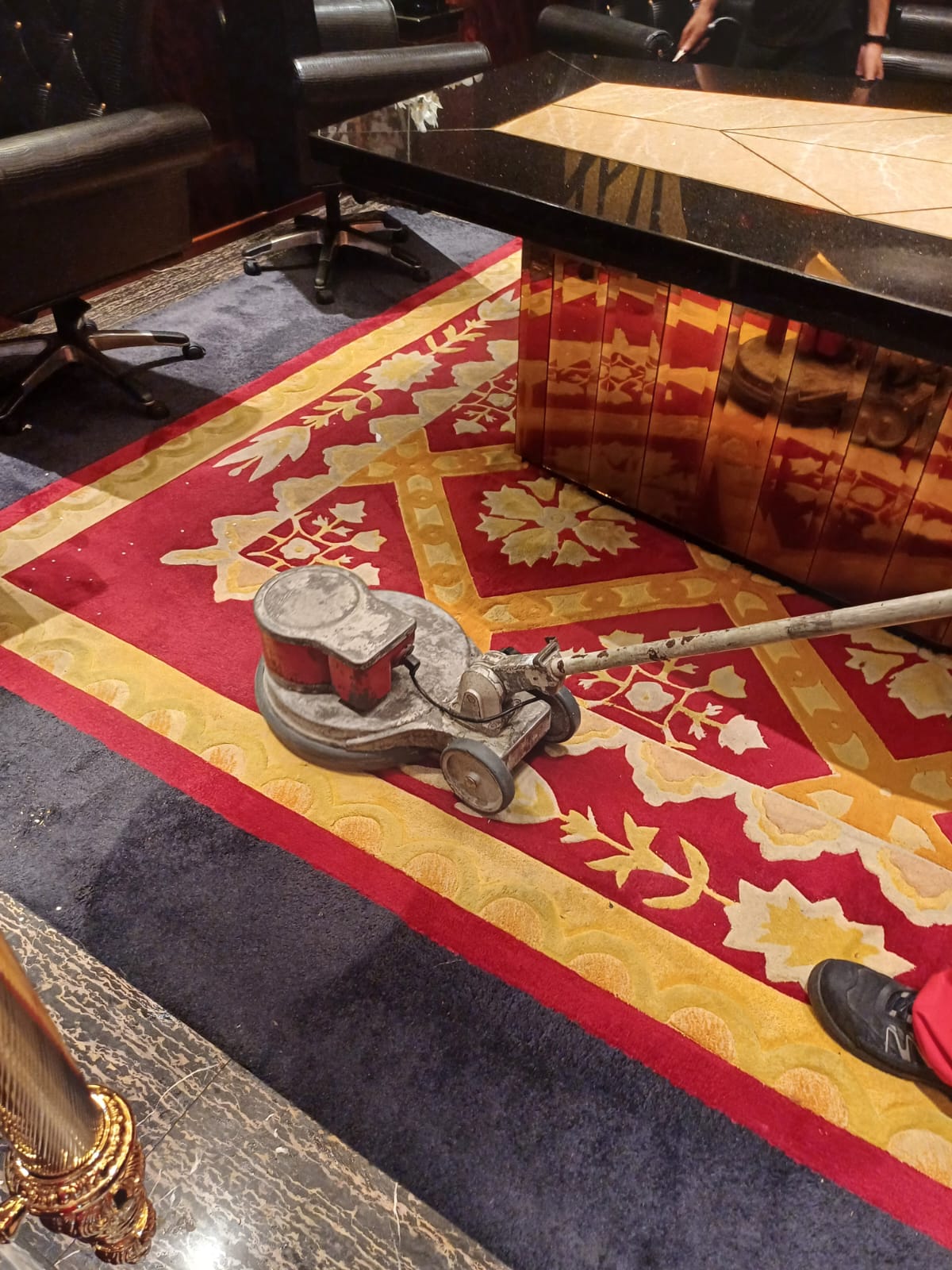
This is one reason professional hot-water extraction uses controlled moisture. Our equipment injects water at high pressure and extracts it almost simultaneously, so the carpet holds far less water than a DIY machine leaves behind. The drying time is typically four to six hours, which matters enormously in Singapore.
DIY shampooing: why the carpet gets dirty faster afterwards
Rented carpet shampoo machines are common in Singapore, and we understand the appeal. They seem thorough, and the dirty water they pull back looks satisfying. But the chemistry of most consumer shampoo formulas works against you.
Consumer carpet shampoos use surfactants that foam heavily. Foam is hard to fully rinse out of carpet pile, and what remains dries as a sticky residue. Soil, dust and pet hair adhere to that residue far more readily than to a clean fibre. Within days or weeks, a shampooed carpet can look dirtier than it did before cleaning.
This is not a flaw in any particular product. It is a consequence of using a formula designed for quick, light cleaning in a situation that requires real extraction. The carpet stain removal process that professionals use is designed to leave nothing behind: our hot-water extraction process uses eco-friendly solutions and high-pressure rinsing to flush the pile clean, with no sticky residue remaining.
The residue test
If your carpet feels stiff or slightly tacky after a DIY clean, residue is the likely cause. Run your hand firmly across the pile. If it feels even slightly gummy or leaves a faint mark on your palm, the shampoo has not fully rinsed out. A professional hot-water extraction clean can usually remove that residue along with whatever soil has stuck to it.
Leaving it too long between professional cleans
Most Singapore homeowners we speak to have never had their carpet professionally cleaned, or have not done so in three or more years. Given that carpets in a Singapore home are exposed to year-round humidity, daily barefoot traffic, and airborne dust that settles in the pile, three years is a long time.
The problem with waiting is that embedded soil is abrasive. Fine grit and dust particles work their way into the base of the pile and cut the fibres with every footstep. By the time a carpet looks visibly dirty or worn, some of that damage is irreversible. Fibre loss, pile crush and permanent dull patches are all consequences of soil that has been ground in over years rather than extracted regularly.
For most Singapore homes, a professional clean once a year is a reasonable baseline. Households with children, pets, heavy foot traffic, or anyone with dust sensitivities are better served by cleaning every six months. Our upholstery and sofa cleaning service follows the same logic: the longer soil sits in a fibre, the harder it is to remove.
What you can do between professional cleans
Regular vacuuming is genuinely useful, provided you use a machine with a good filter and go slowly enough to allow the suction to reach the pile base. Fast vacuuming only lifts surface debris. The standard advice is two passes in opposite directions over each section. Beyond that:
- Remove shoes at the door to reduce soil transfer.
- Address spills immediately (blot, never rub).
- Keep windows closed during and after rain to limit humidity-driven dust settling.
- Rotate rugs and furniture periodically so wear is even.
These habits extend the life of your carpet between professional cleans, but they do not replace extraction.
When to call us, and when you genuinely do not need to
Not every spill requires a professional. A fresh, small spill on a synthetic carpet, blotted immediately and allowed to dry, may leave no mark at all. A light dusting of surface soil in a low-traffic room can wait for a regular vacuum. We are not trying to be the answer to every carpet question.
But there are situations where calling us early saves you money in the long run:
- Any spill involving red wine, turmeric, coffee or pet urine, especially on wool or a light-coloured pile: these set quickly and are harder to remove once dry.
- A musty or sour smell that persists after ventilating the room: this is almost always biological (mould or bacteria in the backing) and will not resolve without proper extraction and drying.
- A carpet that has been shampooed and is re-soiling quickly: residue removal requires professional equipment.
- Any carpet that has not been professionally cleaned in over two years, particularly in Singapore's climate.
Some damage genuinely cannot be reversed. Bleach stains, permanent dye transfer, fibre loss from abrasion, and deep structural damage to the backing are beyond what any cleaning can fix. We will tell you honestly when that is the case, which is why our 30-Day Delight guarantee is a re-clean promise, not a promise of perfect results on every stain.
For properties with area rugs, the rug cleaning process involves different considerations, particularly for wool, Persian and Oriental rugs, where incorrect method or temperature can cause irreversible shrinkage or dye bleed.
Related: see the clients Big Red has served across Singapore, from Changi Airport to Shangri-La Hotel.
Frequently asked questions
How often should I professionally clean my carpet in Singapore?
For most Singapore homes, once a year is a practical minimum. If you have children, pets, or anyone with dust or allergy sensitivities, every six months is better. Singapore's humidity means soil and moisture issues compound faster than in cooler, drier climates, and carpets that go several years without extraction tend to show permanent wear.
Does rubbing a stain ever help?
No. Rubbing spreads the stain outward and drives it deeper into the pile, making it harder to remove and sometimes causing fibre damage. Always blot from the outside of the spill inward, pressing down and lifting rather than wiping. For stubborn stains, a small amount of cold water followed by more blotting is the right second step.
Will a professional clean fix a carpet that smells after a DIY clean?
In most cases, yes. The musty smell that follows a DIY clean is usually residue and trapped moisture in the backing. Hot-water extraction flushes out the residue and extracts the moisture, and our quick-dry process means the carpet is typically dry to the touch within four to six hours, which prevents the conditions that cause the smell to return.
Is Big Red's carpet cleaning safe for children and pets?
Yes. Big Red uses eco-friendly solutions that are safe for children and pets. Hot-water extraction leaves no chemical residue in the pile, and the carpet is dry within four to six hours, so there is no extended exposure to wet chemicals. The process removes around 96% of dust mites, soil and odour, leaving the carpet fresher and cleaner for everyone who uses it.
What happens if I am not satisfied with the result?
Our 30-Day Delight guarantee means we will return and re-clean at no charge if you are not satisfied. It is an honest guarantee: we will do the work again, correctly, because that is how trust is built over 40 years. For stains that are genuinely beyond reversal (bleach, permanent dye transfer, old pet damage that has reached the backing), we will tell you that before we start.
Ready for a fresher, cleaner carpet?
If your carpet is overdue for a professional clean, or if you have a stain, odour or residue problem that DIY methods have not resolved, get in touch. We offer same-day and 24/7 service island-wide, and every job is handled by our own in-house, IICRC- and CRI-certified technicians.
Get a free quote or contact us directly:
- Call: 6241 9443
- WhatsApp: 9222 9222
- Email: info@bigred.com.sg