
A carpet cleaning contract looks straightforward until something goes wrong. A patch re-soils within a week, a technician without proper vetting turns up at a restricted floor, or a stain reappears and the vendor's response is a shrug and a quote for an extra visit.
Facility managers across Singapore deal with this regularly, and the problem almost always traces back to the same place: the contract was signed before anyone asked the right questions. This guide covers what those questions are, what the answers should look like, and how to read the fine print before it costs you.
If you are already familiar with Big Red Carpet Cleaners and want to understand exactly what we offer and stand behind, this is also the clearest account of that.
Why this matters: A carpet cleaning contract that looks adequate on paper can leave a facility exposed to sub-standard work, security gaps and no real recourse when results fall short.
Highlights
- Certifications like IICRC and CRI are the only independent proof a cleaning company has been assessed against international standards, not every vendor in Singapore holds them.
- In-house technicians (never sub-contracted) matter on access-controlled sites: you know exactly who is entering your building.
- Hot-water extraction removes roughly 96% of dust mites, soil and odour with no chemical residue, and carpets are typically dry to the touch in 4–6 hours.
- Big Red has cleaned for Changi Airport, Shangri-La Hotel and 4,000+ island-wide clients since 1986, building nearly 40 years of commercial and residential experience.
- A real service guarantee should specify re-clean terms in writing, not just promise satisfaction.
What certifications actually mean for a commercial contract
Two certifications matter in this industry: IICRC (Institute of Inspection, Cleaning and Restoration Certification) and CRI (Carpet & Rug Institute). Both require technicians to pass assessed training in cleaning chemistry, fibre behaviour, moisture control and restorative methods. Neither is a one-time badge: IICRC certification requires ongoing education.
Big Red was the first IICRC-certified carpet cleaning company in South East Asia. That matters for FM contracts because it means our technicians understand not just how to clean, but what can go wrong: over-wetting that causes mould in the subfloor, alkaline residues that attract soil faster than an uncleaned carpet, or bonnet cleaning on a loop-pile that damages the fibre surface.
Why CRI certification matters for procurement
The CRI Seal of Approval programme independently tests cleaning solutions and equipment against benchmarks for soil removal, re-soiling potential and fibre appearance retention. A CRI-certified cleaner is using chemistry that has been tested, not just marketed as "eco-friendly".
For procurement teams writing tender specifications, requiring IICRC and CRI certification as minimum criteria is the single most effective filter. It removes vendors who have invested in equipment but not in the training to use it correctly.
In-house technicians versus sub-contractors: why it matters on secure sites
This is the clause most FM contracts leave entirely silent. When you hire a cleaning company, are the people who turn up employees of that company, or are they sub-contracted workers the company has never vetted itself?
For office buildings, healthcare facilities, hotels and airports, this is not a minor administrative point. Sub-contracted technicians may not have undergone the same background checks, may not carry the same insurance, and the cleaning company has limited liability if something goes wrong.
Big Red employs all technicians in-house. We have never sub-contracted our cleaning work. Every person who enters your site carries our insurance and has been through our internal training and vetting. For clients like Changi Airport, where access control is non-negotiable, this is the baseline, and it is why we are able to work there at all.
When you are reviewing a contract, ask directly: are the technicians who will clean my site employed by your company? Get the answer in writing. If a vendor hesitates or qualifies the answer, that tells you something.
What to ask about technician training
Beyond employment status, ask:
- Are your technicians IICRC-certified, or only the company as an entity?
- What fibre types do your technicians train on (wool, nylon, polypropylene, sisal)?
- Who is the named supervisor for a commercial contract of this size?
- What is the escalation path if I have a complaint about a specific technician?
A vendor with real in-house capability answers all of these without hesitation.
Reading the cleaning method, and why it matters more than price
Cleaning method is where most commercial contracts are vague in ways that cost you later. "Professional carpet cleaning" could mean hot-water extraction, bonnet cleaning, dry encapsulation or a foam shampoo. These are not equivalent.
|
Method |
Soil removal |
Residue |
Drying time |
Best for |
|---|---|---|---|---|
|
Hot-water extraction |
~96% of soil and dust mites |
None |
4–6 hours |
Deep commercial clean, allergen removal, wool and synthetic |
|
Dry encapsulation |
Surface soil, lighter soils |
Minimal |
30–60 min |
Interim maintenance between deep cleans |
|
Bonnet cleaning |
Surface only |
Can attract re-soiling |
1–2 hours |
Appearance refresh, not a deep clean |
|
DIY foam shampoo |
Variable, often poor |
High re-soiling risk |
12–24 hours |
Not recommended for commercial use |
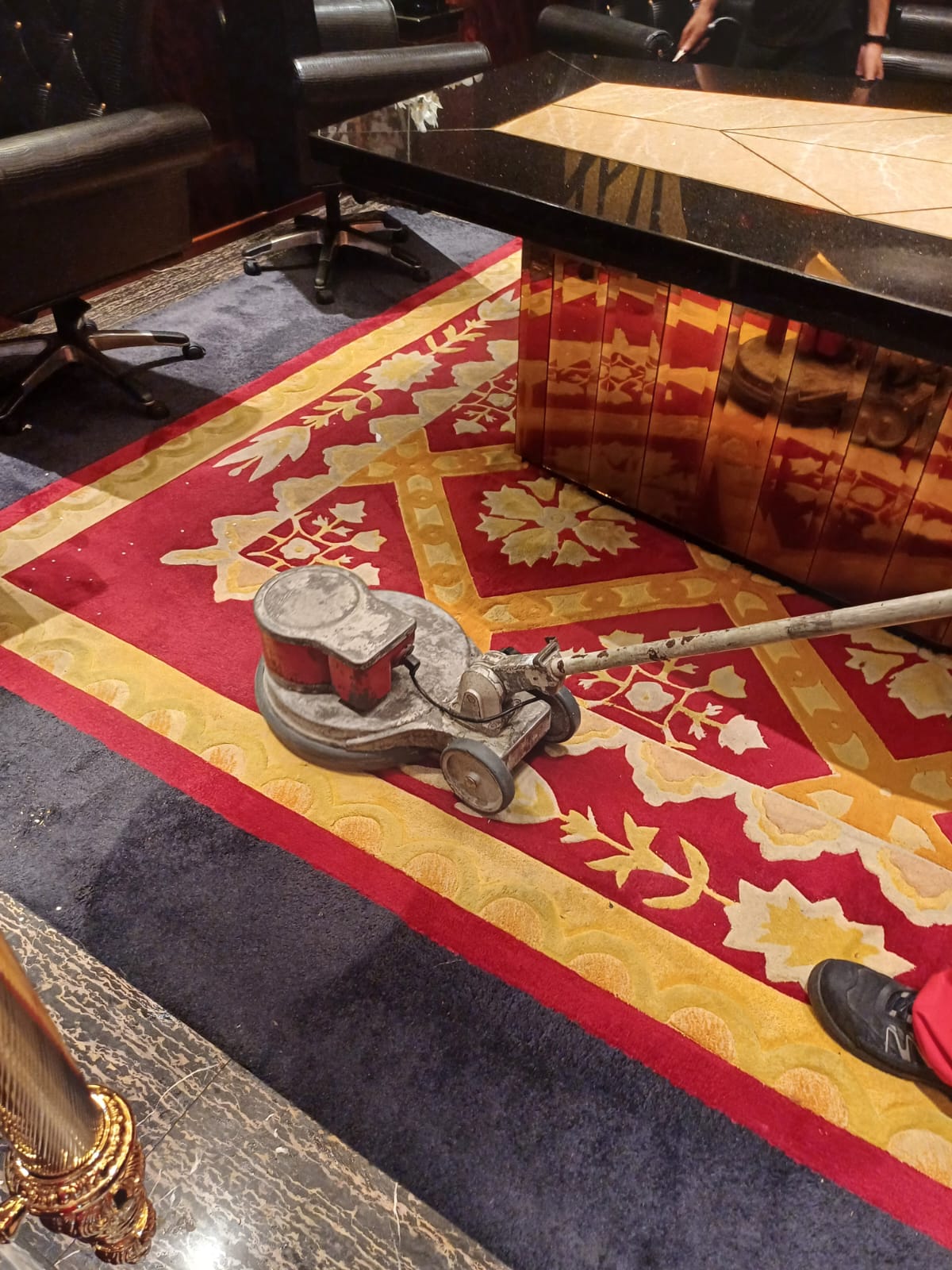
For professional carpet cleaning in a commercial setting, hot-water extraction is the method that removes embedded soil, dust mites and odour at depth. Our process uses eco-friendly solutions that are safe for pets, children and building occupants, with no chemical residue left in the pile. Carpets are typically dry to the touch in 4–6 hours, which means minimal disruption to operations.
Encapsulation is a legitimate interim method between deep cleans. We use it ourselves on high-traffic areas that need a refresh between scheduled deep treatments. What it is not is a substitute for a proper extraction clean.
If a contract quotes bonnet cleaning as the primary method on a regular basis, that is worth questioning. Bonnet cleaning agitates and removes surface soil, but it does not flush the pile, and the friction can damage loop-pile constructions over time.
Eco-friendly chemistry: what to look for
Singapore's indoor air quality standards for commercial spaces are set by the Building and Construction Authority and the Ministry of Manpower. Cleaning chemistry that leaves volatile organic compound (VOC) residues or harsh alkaline deposits can affect occupant comfort and, in healthcare settings, patient welfare.
Ask any vendor for the safety data sheets (SDS) for the solutions they use. If they cannot produce them, do not proceed. Our solutions are eco-friendly, biodegradable and carry no harmful residues. We can provide full SDS documentation for any commercial contract.
What a real service guarantee looks like in an FM contract
A satisfaction guarantee that lives only in marketing copy is not a guarantee. In a commercial contract, a guarantee needs to specify:
- What triggers a re-clean: the specific outcome (visible staining, rapid re-soiling, odour return) and the timeframe
- Who assesses whether the trigger has been met
- The response time for a re-clean visit
- Whether the re-clean is at no additional cost
Big Red's 30-Day Delight guarantee means that if you are not satisfied with the result of a clean, we return and re-clean at no charge within 30 days. For FM contracts, this can be written into the service level agreement explicitly. We encourage it.
Our track record with clients including Changi Airport and Shangri-La Hotel reflects long-term relationships built on consistent results, not one-off visits. Related: see how our clients rate our service.
If a vendor's guarantee is vague about re-clean terms, or ties re-clean eligibility to conditions that are difficult to prove (such as requiring written notice within 48 hours without a clear process for submission), treat that as a flag.
Scheduling, response time and 24/7 availability
For facilities that operate around the clock, hotels, airports, hospitals, data centres, cleaning windows are often narrow and sometimes unplanned. A contract that only offers scheduled visits during business hours is not adequate for these environments.
Big Red offers same-day and 24/7 service. That reflects the reality of clients like Changi Airport, where a spill in a departure hall cannot wait until Monday morning. When you are reviewing a contract, confirm the actual response time in writing for both scheduled and emergency visits, and confirm whether after-hours service carries a surcharge.
Questions to put to any commercial carpet cleaner before you sign
Use this as a checklist. A vendor who is genuinely capable of commercial FM work will answer every one clearly.
- Are you IICRC-certified? Are individual technicians certified, or only the company?
- Do you hold CRI Seal of Approval certification for your cleaning solutions and equipment?
- Are all technicians directly employed, or do you sub-contract?
- What method will you use as the primary clean, and why is it appropriate for our carpet specification?
- Can you provide safety data sheets for all cleaning solutions?
- What is your guaranteed response time for an unscheduled visit?
- What does your service guarantee cover, and what are the exact conditions for a re-clean?
- Can you provide references from comparable commercial clients (by sector and floor area)?
- What is your process if a technician causes damage to a carpet or a building fitting?
For a deeper look at what separates a capable commercial operator from a vendor with good marketing, the article on choosing a carpet cleaning company for your hotel in Singapore covers the same ground from a hospitality angle.
Facility managers looking at broader FM contract structures, including cleaning schedules across multiple sites, will also find carpet and rug cleaning schedules for FM contracts a useful reference before finalising scope.
Frequently asked questions
What does IICRC certification mean for a commercial carpet cleaning contract?
IICRC certification means technicians have been trained and assessed against international standards for cleaning chemistry, fibre behaviour and moisture control. It is the only independent verification that a cleaning company's methods are technically sound. For FM contracts, requiring IICRC certification in the tender specification removes vendors who rely on equipment without the training to use it correctly.
Why does it matter whether a cleaning company uses in-house or sub-contracted technicians?
On access-controlled or secure sites, the identity and vetting status of every person who enters matters. Sub-contracted technicians may not carry the same insurance or have undergone the same background checks as directly employed staff. An in-house team means the company is directly accountable for everyone on your site, which is a meaningful difference if something goes wrong.
How do I verify a carpet cleaning company's credentials before signing a contract?
Ask for their IICRC certificate number (verifiable on the IICRC public directory), their CRI Seal of Approval documentation, and safety data sheets for cleaning solutions. Request references from commercial clients of comparable size and sector. If a vendor cannot produce any of these promptly, that is your answer.
What should a carpet cleaning service level agreement include?
At minimum: the specific cleaning method (not just "professional cleaning"), the frequency and scheduling terms, response time for unscheduled visits, the exact conditions and timeframe of any service guarantee, technician employment status, insurance coverage, and the escalation process for complaints or damage claims. Vague language in any of these areas creates disputes later.
Is Big Red's 30-Day Delight guarantee available for commercial FM contracts?
Yes. The 30-Day Delight re-clean guarantee applies to commercial work and can be incorporated explicitly into a service level agreement. If you are not satisfied with the result of a clean, we return and re-clean at no charge within 30 days. We can document the specific trigger conditions and response timeline to meet your procurement requirements.
Ready to discuss a commercial carpet cleaning contract? Contact Big Red Carpet Cleaners for a free, no-obligation quote. Call us on 6241 9443, WhatsApp 9222 9222, or email info@bigred.com.sg. You can also
Related articles
Get a free quote